
Travel, Power, and Practicing Feminist Leadership in Motion
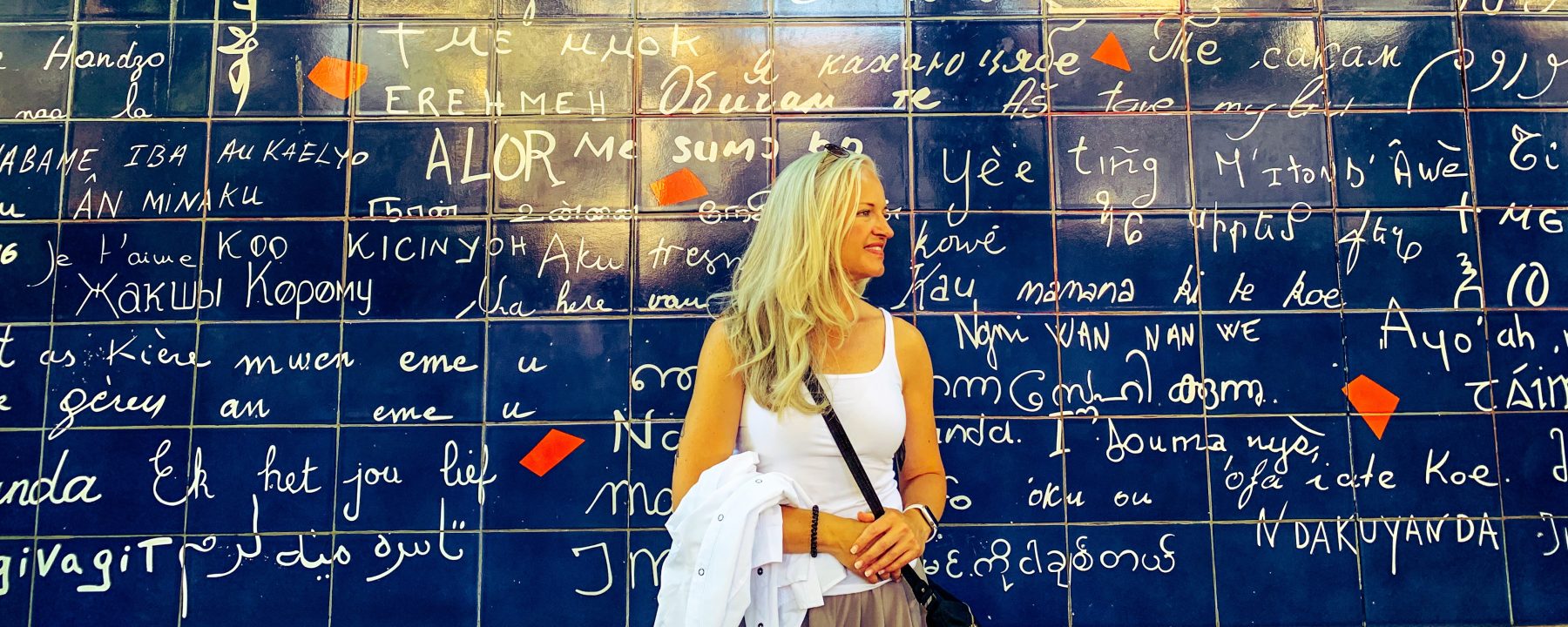
This reflection comes the day after our third LCTE pre-departure meeting, about 45 days before students board a plane for Europe. At this point in the process, excitement is building, logistics are becoming real, and anticipation is high. But this is also the moment to pause and ask a different kind of question–not just where we are going, but how we will move through those spaces.
This conversation is, at its core, about practicing mindful travel: not just seeing new places, but becoming more aware of how we show up within them.
Every summer, before students in the Learning Culture & Technology in Europe (LCTE) program board their flights, we begin with a question that has very little to do with logistics:
Who are you when you travel?
It’s a question that sounds simple but quickly becomes more complicated. Students often begin by describing their personalities, their excitement, or what they hope to experience. But travel has a way of disrupting that framing. It reveals that who we are is not only something we carry; it is something that is interpreted.
When students arrive in another country, they are not just individuals exploring a new place. They are read as Americans. As college students. As representatives of an institution. As people whose identities (racial, gendered, national) carry meaning in different contexts. Before they say a word, they are already situated within systems of perception and power.
This is where travel becomes more than exploration. It becomes a site of leadership, learning, and self-reflection.
As the program leaders, our role in this work is not simply to guide logistics or deliver content, but to help shape how students experience what unfolds. We are co-travelers and witnesses… paying attention to what emerges, modeling mindful engagement, and creating space for reflection in real time. I am constantly reminding myself; I am not outside the experience; I am part of it, navigating the same tensions around presence, identity, and meaning-making alongside students. In this way, leadership is not about having the answers, but about helping us all ask better questions.
The Myth of the “Neutral Traveler”
In dominant narratives about study abroad, travel is often framed as a neutral, individual experience; an opportunity for personal growth, cultural exposure, and adventure. But, over the years in leading LCTE, I’ve learned there is no such thing as a neutral traveler.
To move through the world as a white American college student, particularly from a large public PWI, is to carry both visibility and privilege. It is to be associated (fairly or unfairly) with a country that holds significant global power (note: this is particularly complicated in the spring of 2026). It is to be read through cultural narratives that we did not create but still inhabit.
Students from all backgrounds encounter this quickly. A casual conversation at a cafe turns into a question about U.S. politics. A comment about culture becomes a broader critique. Suddenly, they are asked to explain, defend, or interpret a system much larger than themselves.
This moment often produces discomfort. But it is also an invitation. Some students lean into this moment… not to defend or deflect. Not to represent perfectly. But to practice a different kind of engagement…one grounded in humility, curiosity, and an awareness of positionality.
Feminist leadership asks us to recognize that we are always operating within systems of power. Travel simply makes those systems more visible.
Stereotypes, Perception, and Power
To prepare students for this, I ask them to reverse the lens. If someone visited the United States for the first time… moving through spaces like Times Square or a college football game… what might they assume about Americans?
The answers come quickly: loud, friendly, always on their phones, obsessed with convenience, overly obsessed with hotdogs, deeply political.
None of these are universally true. But they don’t need to be. Stereotypes are not precise descriptions; they are stories shaped by repeated observation and reinforced through media, history, and power.
When students recognize how easily they can generate stereotypes about their own culture, it becomes easier to understand how similar perceptions might exist elsewhere. Ideas about American tourists (e.g. overly loud, overly enthusiastic, constantly comparing everything to home) circulate globally. They are not truths, but they shape interactions.
A feminist lens invites a deeper question: not just what are the stereotypes? but how do they function? Who has the power to define them? Who is most affected by them? And how do we acknowledge and move through them responsibly?
Everyday Interactions, Cultural Norms
Power does not only show up in political conversations. It also lives in the ordinary everyday interactions.
Many American students (particularly those from “midwest nice”) are accustomed to a style of public engagement that emphasizes friendliness… smiling at strangers, making small talk, expressing enthusiasm openly. In many European contexts, public interactions are more reserved. Relationships develop more gradually. Warmth is often built over time rather than offered immediately.
Students sometimes interpret this as unfriendliness. Locals may interpret American behavior as overwhelming.
Neither interpretation is fully accurate. Both are culturally situated.
Feminist leadership, at its core, asks us to resist binary thinking or the impulse to label one approach as right and the other as wrong. Instead, it invites us to notice patterns, ask questions, and remain open to multiple ways of being.
In the U.S., we often begin with warmth and build depth. In many other contexts, people begin with distance and build warmth. Recognizing this difference is not about changing who you are… it is about expanding how you understand others.
The Digital Layer: Presence, Performance, and Belonging
If power shapes how we are seen abroad, technology shapes how we experience it.
Students today are navigating a constant tension between presence and performance. They are deciding whether to immerse themselves in the moment or document it, whether to experience a place or curate it for an audience back home.
When asked to reflect, students rarely lack awareness: last night during our pre-departure meeting, I saw students name the tension clearly. In a “live journal” exercise one student wrote, “I just want to make sure my priority is experience above Instagram.” Another admitted, “I might be taking pictures too much and not looking at it through my eyes rather than my phone.”
Others pointed to the social dimension: “I know it might be hard when everyone else has their phones out,” and “when I want to share with my friends and family what I am doing.” For some, the pull is emotional: “The phone is a constant reminder of the people and places that I’m missing.”
These reflections reveal something important. The challenge is not knowing what matters. The challenge is navigating the systems – social, technological, relational – that make it difficult to act on that knowledge.
Feminist leadership reminds us that individual choices are always shaped by collective norms. Presence, in this sense, is not just a personal discipline—it is a shared practice.
Practicing Feminist Leadership Abroad
So what does shared equity or feminist leadership look like in the context of travel? It looks like curiosity over certainty. Asking questions instead of making assumptions. It looks like consideration. Paying attention to how others move through space and adjusting accordingly. It looks like cultural awareness. Recognizing that you carry identity, nationality, and privilege with you—and that these shape how others experience you.
But more than anything, it looks like a willingness to sit with discomfort. To resist the urge to explain everything, capture everything, or resolve every difference. To recognize that learning often happens in moments of tension.
Travel, in this way, becomes a practice of shared power. Not power over a place or a culture, but power with others—through listening, observing, and engaging with care.
The Invitation
Study abroad is often described as a way to see the world. And it is.
But it is also a way to see yourself… more clearly, more honestly, and more critically.The invitation is not to become the “perfect traveler.” It is to become a more aware one: To notice how you are read, to reflect on how you respond, to move through difference with humility rather than certainty.
Because who you are abroad is not separate from who you are at home… It is simply more visible.
And in that visibility, there is an opportunity; not just for learning, but for practicing a different way of leading in the world.
Forty-five days before departure, this conversation is less about preparation and more about intention. Mindful travel doesn’t begin on the plane mid-flight, it begins here, in the willingness to reflect. If students start that work now, they won’t just arrive somewhere new when the program begins… they’ll arrive differently.
More on my travel blog coming soon!
 Heather Shea, Ph.D.
Leave a comment