
Twenty-five years after September 11, 2001, I have been thinking a lot about what I want to say about this anniversary. I am 52, which means nearly half of my life—and almost all of my professional life working in higher education—has been lived in a post-9/11 world.
There is much that could be written about those 25 years: war, terrorism, Islamophobia, changes to national security, political division, and the many ways that one September morning altered our country and our world. But that isn’t the story I keep coming back to today.
Instead, I keep thinking about September 12—and about the work of Student Affairs.
On the morning of September 11, 2001, I was sick. It seems like such an insignificant detail, but it is central to how I remember that day.
I had graduated from my master’s program in 2000 and taken my first professional position. In May 2001, my then-partner and I left our jobs and moved across the country to Tucson, Arizona. A few months later, I started a new position in the Center for Student Involvement and Leadership (in the Division of Student Affairs) at the University of Arizona. I hadn’t been there very long when September arrived.
On September 11, I woke up not feeling well. Arizona doesn’t observe daylight saving time, so it was still early when my partner was getting ready for work and I was determining if I was going to stay home that day. As he often did in the mornings, he turned on Good Morning America. Charlie Gibson and Diane Sawyer were reporting about an explosion at the World Trade Center.
We watched the live coverage of smoke pouring from one of the towers. Like so many people watching that morning, I initially understood it as a terrible accident. Then we watched the second plane hit, and everything changed.
There was another layer to what I was seeing on television that morning. Earlier that year, I had been in New York City with my grandmother. I think it was February—we are bundled in winter coats in the photographs. We took the ferry to Ellis Island, and I snapped a photograph of her standing on the deck with the Manhattan skyline behind her. There, unmistakably, behind my grandmother are the Twin Towers.
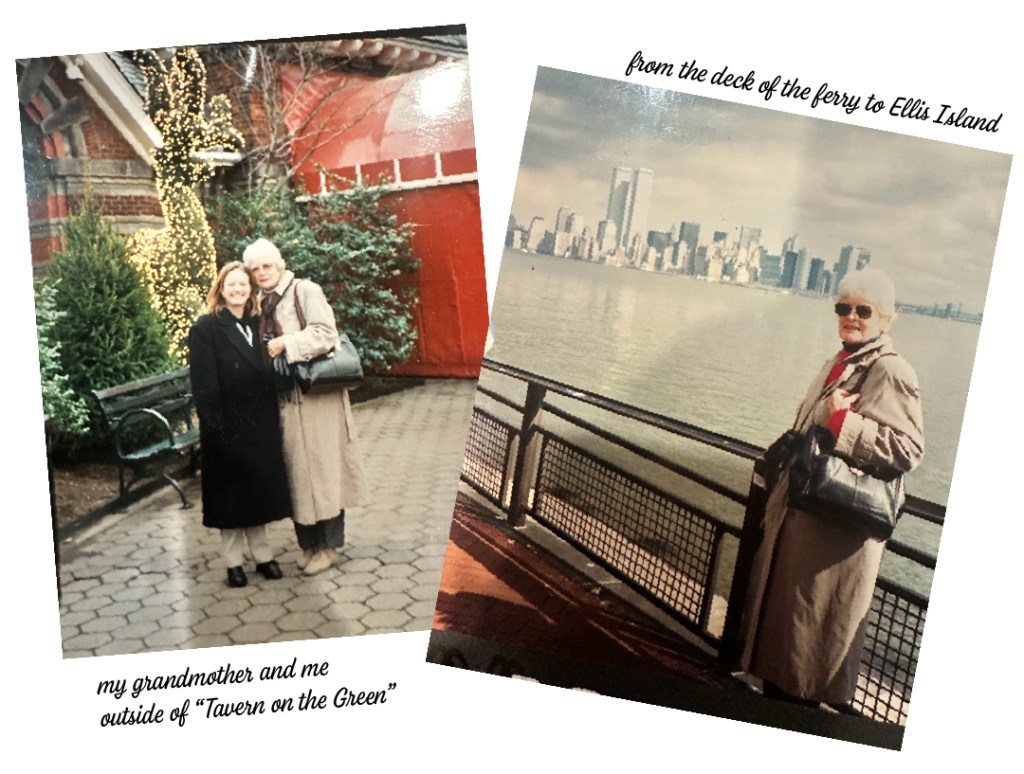
I couldn’t have known when I took that photograph that just months later the skyline behind her would no longer exist. As I sat thousands of miles away in Tucson watching those buildings burn, New York wasn’t entirely an abstraction to me. I had just been there. I had looked at that skyline with my own eyes and photographed someone I loved standing in front of it.
Looking at that photograph now, there is something haunting about its ordinariness. It captured a moment before any of us knew there would be a before and an after.
I don’t remember exactly when my partner left for work. I remember eventually moving from the bedroom to the living room with a box of Kleenex and watching television for hours. The endless news coverage is mostly a blur now: people walking through Manhattan covered in ash, office workers still in their suits making their way uptown on foot, photographs and handmade signs searching for missing family members, reports about the Pentagon, and stories of phone calls made from Flight 93 as passengers began to understand what was happening. And, eventually, the towers falling.
By the end of the day, I was not okay. But strangely, when I think about September 11 now, those aren’t my strongest memories. September 11 is one big blur of horror.
My strongest memories are from the day after.
I went to work on September 12.
The University of Arizona was a destination institution for many students from the East Coast, including New York and the surrounding area, and in the immediate aftermath of the attacks, the university mobilized. A space in the student union became a gathering place for students. Televisions connected to cable were brought in. Mental health professionals were available, alongside Student Affairs staff who were themselves trying to comprehend what had happened while helping students do the same.
There were boxes of Kleenex—lots of Kleenex—and there were people. For the next several days, we held space.
That phrase, holding space, gets used a lot now, but I am not sure I understood what it meant until then. Not every student needed counseling. Some did, while others needed to talk, get information, call home, cry, or simply sit in a room with other human beings because being alone felt impossible.
There wasn’t a program that could fix what had happened or a workshop that could make anyone understand it. There certainly wasn’t an assessment or learning outcome capable of capturing what students needed in those hours.
They needed community, and our job was to help create it.
At some point while staffing that space, I realized I needed community, too. I had spent September 11 alone for much of the day, sick on my couch and watching something horrific unfold thousands of miles away. Now I was surrounded by students and colleagues carrying their own fear, grief, anger, confusion, and disbelief. I realized I couldn’t only be the person helping. I needed somewhere to put my own grief and questions.
There was a service being held at the chapel on campus, and I remember thinking very clearly: I need to go. I needed to sit among other people and wrestle with questions for which there were no answers—including how a God understood as loving and all-powerful could allow something so horrific to happen.
I needed what our students needed. I needed community.
Twenty-five years later, I understand that experience as one of my earliest lessons about the work I have spent my career doing. When tragedy happens on a college campus—or when tragedy from somewhere else arrives on our campuses through the lives of our students—Student Affairs professionals are often among the people who step into the space between what has happened and what comes next.
We cannot undo the tragedy, answer every question, or eliminate grief. But we can make sure people don’t have to carry it alone.
I would learn that lesson again many years later, much closer to home. On February 13, 2023, a gunman came onto Michigan State University’s campus and killed three of our students and wounded five others. Once again, the unimaginable became real, and once again, I watched Student Affairs professionals respond.
Counselors supported students carrying trauma and grief. Staff created spaces for students to gather. Listening circles brought people together. People checked on students, colleagues, friends, and strangers. Staff helped students navigate academics, housing, transportation, family concerns, fear, and the complicated process of returning to a campus that suddenly felt different.
Colleagues across the country also reached out with resources, guidance, and support. Sadly, many knew what to do because their own campuses had experienced acts of gun violence. They shared lessons learned, offered practical tools, and reminded us that we were not alone—not only in our grief, but also in the difficult work of caring for a campus community after violence.
And all of this work was being done by people who were themselves members of the community experiencing the tragedy. That part matters.
One of the lessons I carried from September 12, 2001, and relearned on February 13, 2023, is that Student Affairs professionals do not stand outside the communities we serve. We are part of them. We grieve and get scared, too. We experience trauma and steward Sometimes we need the Kleenex or the counselor. Sometimes we need to sit quietly beside someone because we don’t know what to say.
And still, we show up.
Laura van Dernoot Lipsky calls this “trauma stewardship”—recognizing both the privilege of being called to help and the responsibility to care for ourselves as we care for others. I didn’t have that language on September 12, 2001, but I understand it now. Going to the chapel that day wasn’t stepping away from my responsibility to students. It was recognizing that I was part of the grieving community, too.
There is a great deal of conversation in higher education right now about the value of college and what students receive from their institutions. Those are important conversations. But I sometimes worry that in our attempts to quantify value, we overlook the things that are hardest to measure: belonging, care, connection, and community.
It is the person who notices when a student isn’t okay. The staff member who stays in the student union because a student doesn’t want to be alone. The counselor who creates space for grief and loss. The people who organize listening circles, vigils, and support spaces. The people who help a campus begin the long process of figuring out what comes next.
I didn’t know it on September 12, 2001, but I was learning one of the most important lessons of my career: Student Affairs is not only about helping students succeed when things are going well. Sometimes our most important work happens when nothing is going well.
Sometimes the work is opening the door, pulling up a chair, putting a box of Kleenex on the table, and saying, You don’t have to be alone right now.
Twenty-five years later, that still feels like work worth doing.
Resources:
Laura van Dernoot Lipsky with Connie Burk. Trauma Stewardship: An Everyday Guide to Caring for Self While Caring for Others. Berrett-Koehler Publishers, 2009.


Leave a Reply